As a business that handles large quantities of money, you’ll find that counting huge sums of money manually can be time consuming. It can also be subject to human error while limiting business productivity.
For businesses that deals in cash regularly, a bill counter machine provides a faster and more convenient way to count banknotes without the hassles of manual counting.
If you’re wondering what a Bill Counter is all about and how it works, I’ll be explaining just that in this guide, including how these counters operate, their main components and the functions that make them useful for businesses.
What Is a Bill Counter Machine?
A bill counter is a cash handling device that is designed to count, stack and process bank notes for accurate and easy cash handling.
It is one of the larger collection of counting machines, popularly used by organizations and businesses of different kinds for cash handling.
Why it is Different from other Money Counters
A bill counter is a low-cost counting machine designed for smaller businesses.
It comes with solid capabilities like fast counting speed, batching capabilities, fake note detection mechanism etc. while selling at more affordable rates.
While the name is sometimes also loosely used for counting machines generally in some cases, a bill counter is also the standard name for a more affordable and entry level counting machine brand.
Like the Bill Counting Machines here, distributed by SGI Global Enterprises, for instance.
How a Bill Counter Machine Operates
The machine works by feeding banknotes individually through an internal counting mechanism.
After a user inserts the notes, electronic sensors detect each passing note, while an integrated counting system calculates and displays the total number of currency notes processed.
Outside regular bank note counting, most bill counters do also offer additional functions like batch counting, addition, ultraviolet (UV) detection and magnetic (MG) detection.
These features make bill counters useful for businesses such as banks, supermarkets, retail stores, POS operators and most importantly, smaller scale businesses.
How Does a Bill Counter Machine Work?
A bill counter machine combines a mechanical feeding system, electronic sensors and a digital counting mechanism to count banknotes automatically.
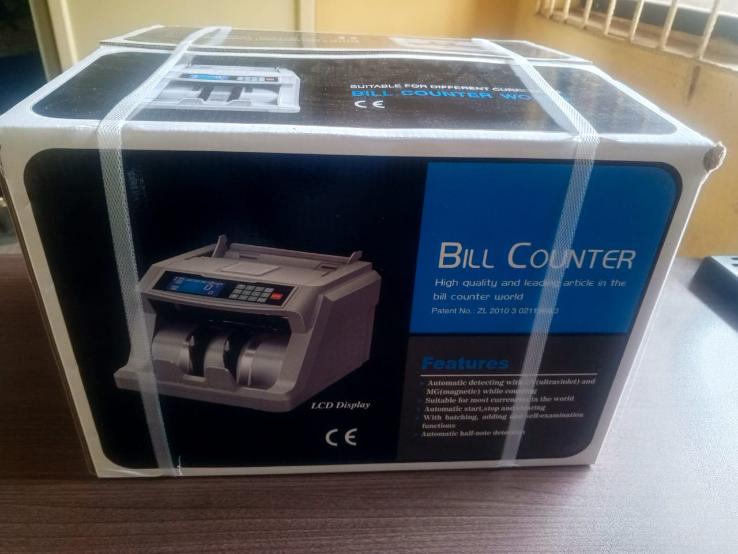
The process typically involves five steps:
- Loading the banknotes: You place a stack of banknotes into the machine’s hopper, which is the compartment where notes are loaded before counting.
- Feeding the notes: Internal rollers and friction mechanisms separate the banknotes and feed them individually through the machine.
- Detecting the notes: Electronic sensors detect each banknote as it passes through the counting system.
- Calculating the count: The machine’s electronic control system registers each detected note and updates the running total.
- Displaying the result: The total number of banknotes counted appears on the machine’s digital display after counting.
This process happens automatically, allowing a bill counter to process hundreds of banknotes within a very short period.
Main Components of a Bill Counter Machine
Although designs differ between models, most conventional bill counting machines have several essential components you can easily find across machines with different brand names like:
- Hopper: Holds the banknotes before they enter the feeding mechanism.
- Feeding rollers: Move and separate banknotes so they pass through the machine individually.
- Counting sensors: Detect passing banknotes and send signals to the electronic counting system.
- Control panel: Allows users to operate the machine and select available counting functions.
- Display screen: Shows the number of notes counted and relevant operating information.
- Stacker: Collects banknotes after they have passed through the counting mechanism.
These components work together to ensure that banknotes are fed, detected and counted automatically after they are inserted into the machine.
Important Functions of a Bill Counter Machine
Modern bill counters offer several functions beyond basic note counting. If you’re buying a bill counter today, it can serve your business in any of these areas:
Automatic Counting: Automatically counts banknotes once they are properly loaded and the machine is activated.
Batch Counting: Allows users to divide banknotes into predetermined quantities. For example, a user can set the machine to count batches of 50 or 100 notes.
Addition Function: Combines successive counting results to provide a cumulative total. This is very useful when counting large quantities of banknotes in separate batches.
UV Detection: Uses ultraviolet technology to examine certain security characteristics of banknotes and help identify suspicious notes.
MG Detection: Uses magnetic sensors to check for expected magnetic characteristics associated with certain banknote security features. This together with UV Detection can help in identifying fake notes.
Half-Note Detection: Some models can identify incomplete or incorrectly sized banknotes and alert the user.
The availability of these features varies by machine model, so it is important to check the specifications before purchasing.
Can a Bill Counter Machine Detect Fake Banknotes?
Most bill counter machines do have counterfeit detection features designed to identify potentially suspicious banknotes.
Common technologies include ultraviolet (UV) and magnetic (MG) detection. UV detection examines the ultraviolet properties of banknotes, while MG detection checks for expected magnetic characteristics.
While all counting machines do not have this capability, the bill counter machines we sell do have the fake note detection feature.
Does a Bill Counter Machine Count Money by Value?
A conventional bill counter primarily counts the number of banknotes but not their total monetary value.
For example, if you insert 100 notes of NGN1,000 and 50 notes of NGN500, a basic bill counter will display 150 notes.
A multi-currency bank note counting sorter like the ones we sell here, on the other hand, can identify supported denominations and calculate their combined monetary value.
This distinction is important when choosing cash-counting equipment, as the two machines do serve different purposes.
Frequently Asked Questions
How fast can a bill counter machine count banknotes?
Counting speed depends on the model. Some machines process several hundred notes per minute. Our bill counting machines do count as much as 900 notes per minute.
Why does a bill counter machine sometimes count incorrectly?
Incorrect counting can result from dirty sensors, worn feeding rollers, improperly arranged banknotes or mechanical problems. Proper cleaning and maintenance can help reduce these issues.
Can a bill counter count different currencies?
Some bill counters can handle different currencies, but capabilities vary by model. Basic counting machines generally count the number of notes rather than identify their currencies or denominations.
What is the difference between a bill counter and a money sorter?
A bill counter primarily counts banknotes, while a money sorter separates notes according to characteristics such as denomination or condition, depending on the machine’s capabilities.
Get a Suitable Bill Counter Machine for Your Business
Bill counter machines combine mechanical feeding systems and electronic counting technology to make cash handling faster, more convenient and less expensive.
For businesses that regularly handle large quantities of cash, you can reduce the time spent on manual counting and improve operational efficiency with a bill counter.
SGI Global Enterprises Limited supplies bill counter machines for businesses in Nigeria. Explore our range of bill counter machines to find suitable equipment for your business.


